


Toilet Rough-in Sizes and Dimensions: 10, 12, 14 Inch
Toilet Rough-in Sizes: What They Are and How to Measure
Rough-in is the distance from the finished wall to the centre of the waste pipe. It decides whether a toilet fits at all.
Get it wrong and the toilet will not fit. You must break the ceramic and move the pipe.
This guide covers standard toilet dimensions and the three rough-in sizes you will order.
It also shows how to measure rough-in correctly and which models match each size.
Standard Toilet Rough-in Sizes
Three rough-in sizes cover almost every project worldwide:
| Rough-in | Metric | Where it is used |
|---|---|---|
| 10 inch rough-in | 250 mm | Europe, Asia, Middle East, small bathrooms |
| 12 inch rough-in | 300 mm | North America, and most new construction |
| 14 inch rough-in | 355 mm | Older homes, larger bathrooms, luxury builds |
12 inch is the default in North America. About 85% of US homes use it. Most US distributors stock it.
10 inch is the European and Asian standard. The UK and Ireland also use it for retrofit work.
14 inch appears in older North American homes. Stock runs short, so confirm it early. Do not plan to convert it on site.
One common mistake: specifying a 12 inch toilet for a 10 inch bathroom. The difference is structural, not cosmetic.

The FR1506 one-piece toilet: 12 inch rough-in, 420 mm bowl height, cUPC and WaterSense certified.
How to Take a Correct Rough-in Measurement
Measuring takes five minutes. Guessing costs a container of porcelain.
1. Measure from the finished wall, not the structural wall.
2. If tiles are still to be laid, add 10–12 mm for tile and adhesive.
3. Measure to the centre of the pipe, not the pipe edge.
4. Measure at floor level, then again at seat height. Both readings match on a plumb wall.
5. Photograph the reading with a tape measure in frame.
If the readings differ, the wall is out of plumb. Decide before the toilet ships.
With the right figure, the rest is routine. Our step-by-step toilet installation guide covers the fitting stage.
S-trap or P-trap?
The trap is the bend in the waste pipe. Its type sets which toilets fit a given rough-in.
S-trap means the outlet runs back into the wall. Europe and Asia use this standard.
P-trap means the outlet drops into the floor. North America uses this standard.
Rough-in and trap differ, but both matter. Buyers mix them up second most often.
Several of our models, including the FR24101 two-piece toilet, ship as P-trap with an S-trap adaptor available. That keeps the project flexible when the trap is not yet fixed.
What is an S-trap adaptor?
It is a fitting that redirects a floor outlet into the wall. You fit it between the toilet outlet and the waste pipe.
It lets one toilet model serve both S-trap and P-trap projects. Ask for it at the quotation stage, not after delivery.
Can I convert a P-trap toilet to S-trap?
Yes, if the model offers an adaptor. Not every model does.
Check the product page or ask your supplier before you order. Converting on site costs more than ordering the right version.
Which trap do European projects use?
Most European and Middle East projects use S-trap, with the outlet going back into the wall.
UK and Ireland retrofit work varies. Confirm the existing pipe direction before you specify.
Rough-in and Bowl Height Go Together
Rough-in is horizontal. Bowl height is vertical. Rough-in decides if the toilet fits. Bowl height decides comfort and accessibility.
The ADA Standards for Accessible Design set the rule.
An ADA compliant toilet needs a seat height of 17–19 inches (430–485 mm) above the floor. Measure it with the seat installed.
For North American projects, the FR1506 reaches ADA range once you fit a standard seat.
For European projects, 400 mm is the usual comfort target. Our FR1504 sits at 400 mm.
For entry-level projects, 385 mm is the traditional height. Our FR1502 uses this height.
Water Efficiency Standards in 2026
Water efficiency now decides which products win tenders. This is the fastest-moving rule in the industry.
China's Water-Saving Sanitaryware Standard sets Grade 1 efficiency at 4.0 litres per flush or less. Cities use it as a bid threshold.
Any 4.0 litre flush model must clear this bar to win municipal tenders. Most buyers search for a water efficiency toilet by this number, not by a brand name.
In North America, WaterSense certification is the equivalent benchmark. The FR25203 and FR1506 both carry it.
European buyers look for the EU water label and CE or UKCA marking. The wrong certification blocks customs clearance.
If a project asks for a 3.5 litre flush, confirm the flush curve before you order. Not every 4.0 litre model reaches 3.5 litres. A 3.5 litre flush needs a real test report, not a brochure claim.
Which Models Match Which Rough-in
All models below come from current verified production data. Check the product page for full dimensions before you order — it remains the controlling reference.
12 inch / 300 mm rough-in (S-trap)
FR1506 — ADA design one-piece toilet, 420 mm bowl height, cUPC and WaterSense.
FR1508 — fully skirted one-piece toilet, 405 mm bowl height, cUPC.
FR1504 — Votex siphonic, 400 mm bowl height.
FR1501 — elongated, fully skirted one-piece toilet, cUPC certified.
FR24105 — vitreous china toilet, one-piece format, rough-in available in 220, 250 and 300 mm.
FR25203 — two-piece siphonic tornado, cUPC, MAP and WaterSense.
10 inch / 250 mm rough-in and 180 mm
FR1505 — one-piece siphonic, also available in 300 mm.
FR24107 — two-piece rimless, 180 mm, P-trap, CE.
FR24101 — two-piece, 180 mm, P-trap with S-trap adaptor option.
FR34107 — wall-hung toilet, rimless, 180 mm, built for hotel projects.
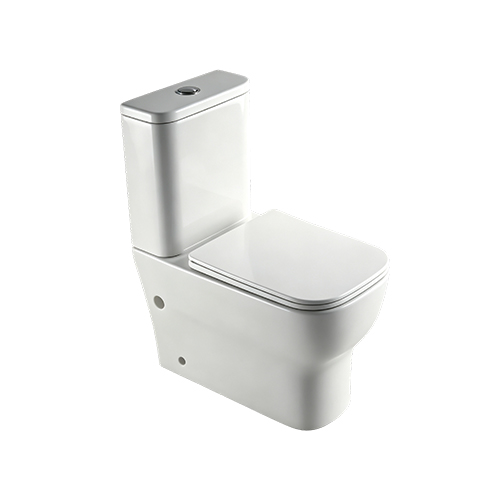
FR24107 two-piece toilet: 180 mm rough-in, rimless wash-down, CE certified.

FR34107 wall-hung toilet: 180 mm rough-in, made for hotel projects.
Five Mistakes That Cause Real Problems
1. Specifying a 12 inch toilet for a 10 inch project. This is the most expensive mistake after delivery.
2. Forgetting bowl height. A 385 mm bowl fails an accessible restroom.
3. Measuring from the structural wall instead of the finished wall. The finished wall adds 10–12 mm.
4. Assuming "skirted" means "concealed". A skirted trapway only hides the pipe. It does not change the rough-in.
5. Ordering before confirming certification. cUPC and WaterSense are North American. CE and UKCA are European.
Frequently Asked Questions
What is a standard toilet rough-in size?
300 mm (12 inch) is the standard in North America. 250 mm (10 inch) is the standard in Europe and Asia. 355 mm (14 inch) covers older and larger bathrooms.
Can I install a 12 inch toilet on a 10 inch rough-in?
No. The toilet will not sit against the wall, and the outlet will not line up.
You need either the correct model or an offset flange. Ask before you ship, not after.
Should I measure before or after tiling?
Measure from the finished wall, so after tiling. If tiles are not laid yet, add 10–12 mm to your reading.
Getting this wrong moves a 12 inch project into the 10 inch range.
Do your toilets include an S-trap adaptor?
Not by default. Several models offer it as an option, including the FR24101.
State the trap type in your enquiry and we will confirm availability for the exact model.
What is the difference between rough-in and trapway?
Rough-in is a distance: wall to pipe centre. Trapway is the shape of the internal channel.
Rough-in decides fit. Trapway decides flush performance and how much of the pipe you see.
What to Confirm Before You Order
Confirm four items in writing before you fix a model:
1. The rough-in of the bathroom where you will install the product.
2. The trap type required.
3. The certification required in the destination market.
4. The local building and plumbing code in force on the project. Jurisdictions differ, and a code can add a requirement that a catalogue does not list.
As a toilet manufacturer and ceramic toilet supplier, we build to the rough-in standard of each market. We have supplied Europe, North America, the Middle East and Asia since 1996. Every quotation lists the exact model, dimensions and certificates.
Send us the rough-in, trap type, bowl height preference and quantities.
Ceramic washbasins, pedestal basins and toilet seats can go on the same order.
Include your project details for a specification-matched quotation.